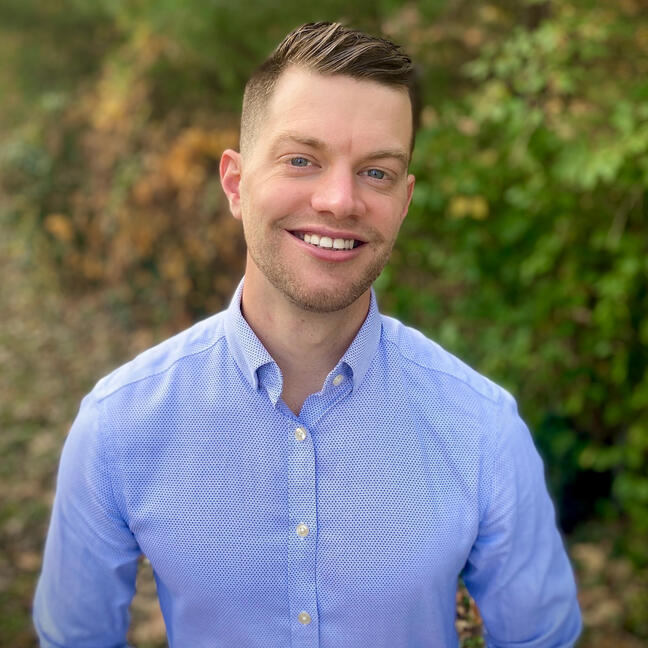
Jake Gammon
Sharing knowledge. Pursuing curiosity.
We're all learning. Below are topics I'm excited about and pursuing. Let's grow together.
FINANCIAL SERVICES
Gaining and distributing knowledge to demystify and enhance personal finance. For me, and for you.


TECHNOLOGY TRENDS
Moving towards what can be instead of what is.
faith and philosophy
We are all good by nature. We're searching for the courage to see it in ourselves and in others.

personal finance

As a lending strategist for a top-10 US bank, I'm privileged to lead and advise the most affluent clients within the bank in Pennsylvania, Virginia, Ohio, Kentucky, West Virginia, and Tennessee. With a minimum of $5MM in liquidity, my clients are interested in strategies to borrow money that are both out of the box and that protect their existing wealth while growing it. I help clients see the value in interest rate arbitrage with securities-backed lending, capital gain advantages of long-term financing vs. liquidating assets, estate planning tactics in self-cancelling promissory notes to family members, trust pledging, and more. The beauty is that I see so many clients and hear their stories. It's enjoyable to get to know them and their unique issues they are aiming to solve.
Currently, my curiosities are turning to the future of stores of value. The vast majority of humans around the world currently use the US Dollar as the best way to store purchasing power. The future of preserving purchasing power is at least partially solved by cryptocurrency (aka Bitcoin, Ethereum, etc.). I believe the mass adoption of cryptocurrency has just begun and as our reliance on a centralized peg of value and stability continues to be challenged by shaky printing of trillions of dollars (most of which go to foreign entities), a detached Wall Street, and a growing need for anonymous/secure transactions, cryptocurrency will grow in desirability and utility. Investment portfolios that were previously relegated to equities and bonds will be held responsible for managing/hedging devaluation of the US Dollar in conjunction with managing traditional returns.
Here are some things that I'm reading and pondering about in the personal finance world:
Why Crypto:
https://winklevosscapital.com/the-case-for-500k-bitcoin/
Crypto For Inheritance Planning:
https://www.youtube.com/watch?v=GAxteKBdtdU
Lending against Bitcoin:
https://www.lendacademy.com/podcast-143-blake-cohen-of-salt-lending/
Technology Trends

I get energized thinking about what is possible and allowing the mind to wander outside of the boundaries of what is expected. Specifically, the frontiers of self-driving cars, space travel, golf technology, and cryptocurrency.
The industries and trends appear to be unrelated. However, when viewed through the lens of picturing the normal day of a human in 5,10, or 15 years it becomes useful to examine the trends to invest in different direct or indirect technologies that support them.
The autonomous vehicle is more than the freedom to snooze on the highway or watch TV on the way to Starbucks. It will change the way we interact with travel and all aspects of our daily lives that are tangentially connected to it. Home values far from the city center will begin to increase as commute times to the city are less important. Downtown parking lots will be gone after vehicles drop you off, return to a less congested area to park, and then come back to pick you up (parking lots in general will be optimized since the cars don't need room to open doors). Car ownership will be shared (or turned to robotaxis when not in use), auto insurance will drastically decrease as accidents decrease, cars will form long convoys driving only inches behind the one in front tethered together by software to minimize wind drag, and state laws will be formed to regulate how self-driving softwares have to prioritize human lives, and so much more. We're at the beginning of a new relationship with travel and the world around us will change as a result.
Space travel is being revolutionized and privatized. We're democratizing space travel and decentralizing it from the government. This makes innovation rapid and allows space travel to be solved using a new lens of possibilities. The folks at SpaceX are launching rockets and landing them on autonomous boats, which is the equivalent of throwing a pencil off the Empire State building and it landing on its eraser--a strategy that was not considered until space programs were removed from government control. That model of rocket re-usability has sparked an entire new space age that is being copied by companies and governments around the world. Economically that has major positive implications on the eventual traveling to and colonizing of Mars and the moon. (Fun thought experiment: what laws will govern the moon and Mars?) Physically, the human body of those people on Mars and the moon will change, stretched and grown taller as less gravity is forced upon our backbone (albeit slowly).
Golf is being introduced to mathematics and statistics. Thanks to Mark Broadie, a professor at Columbia Business School, players are statistically breaking down their rounds to figure out what part of their game needs more practice. Bryson DeChambeau is on a mission to remove variability from his golf swing by locking his arms at the limit of their rotation before swinging. Every shot hit on the practice range is watched by a launch monitor and measured. Those same launch monitors are getting smaller and less expensive and as a result people are building golf simulators in their homes, which enables more rounds of golf and less time for each round. Real golf will face pressure to shorten rounds and cater to the busy individual, or die at the hand of virtual golf.
Cryptocurrency and the blockchain concepts have the very real possibility of providing the foundation of harnessing the internet to make our physical lives more profound. By applying blockchain to anything (and I do mean anything) companies have the ability to decentralize and make transparent all things that require a central, trusted point of contact. While there are limitless ways to apply this technology, suffice it to say that the blockchain is a mathematical way to digitize and automate the physical. It is the internet-izing of stuff. And it's only just beginning.
From here, we will see new worlds being built entirely on the digital platform. Physical space within these worlds can be purchased and verified by using blockchain. Once owned, the space can be rented out for virtual events, or sold to companies for advertising space, or even used to build something functional and charge for utilizing it (virtual arcade, art gallery, movie theater, etc.). This is a migration to the physical world being replicated, and replaced by the digital.
Here are some links that I am reading and pondering:
What Mars colonization looks like:
https://www.spacex.com/human-spaceflight/mars/
3D Printing Habitats on Mars:
https://www.nasa.gov/directorates/spacetech/centennial_challenges/3DPHab/index.html
Formulating Laws for Autonomous Vehicles:
https://www.hks.harvard.edu/faculty-research/policy-topics/cities-communities/implications-self-driving-vehicles-public-policy
Virtual World built on Blockchain: https://docs.decentraland.org/decentraland/introduction/
Faith and philosphy

There is a strong divide between religion and spirituality and its important to differentiate the two. Religion is the humanization of spirituality and in doing so, we're condensing the mystery and impact of spirituality. In tech terms, its similar to compressing the transmission rate between what is happening in our souls (immense, unexplainable, unknowable) and turning it into words. By converting that infinite experience of soul into a finite list of words by nature we're reducing its authority and power, and claiming control of it. By claiming control of it, we are stripping away the divine nature and staking it as a human distillation.
Spirituality is a journey and currently I'm working through the interpretations of Richard Rohr, a Franciscan monk, who identifies with christian mysticism. Admittedly, I don't like the term 'mysticism' as it conjures images of wizards and warlocks, but at its core it teaches full inclusion for all people, experiencing Christ and God through the body, mind, and soul, and seeing other humans as those that are created by, and loved by, God. In short, it peels back religion and reveals the fruit of early christianity.
These interpretations align with my general philosophy that people are inherently good and it is up to us to seek it out and find that good in everyone. As I look around the world, I believe that at a singular level of interacting with each other, we've lost the courage to see the good in people. It is far easier and safer to see the neutrality in people (or even negativity), than it is to believe that there is good that is left to be uncovered. Seeing the neutrality in people removes the requirement of action from our part and instead replaces it with a consensus of passivity, which leads to an erosion of community and an increase in our sense of individualism. I include myself in that assessment and am equally responsible as any other individual. Contemplation and self-analysis is a key cornerstone in early christianity and indeed in christian mysticism and both are critical if we are to grow as individuals towards a cohesive and loving community.
Consider this: if Jesus was the pinnacle of humans, the best of us, the model for our lives and he was naked, vulnerable, powerless, and poor....what does that say about what qualities we should be pursuing?
Some links to things I'm reading and pondering:
Richard Rohr Daily Meditation:
https://cac.org/a-commandment-to-love-2020-11-08/
Universal Christ:
https://www.amazon.com/Universal-Christ-Forgotten-Reality-Everything/dp/1524762091